

Part I: The Introductory Rites
Stand1. Entrance, Sign of the Cross & Greeting
The priest and congregation begin by making the Sign of the Cross together in the name of the Trinity. The priest then welcomes the assembly with a scriptural greeting, and the people respond in unity.
Why does the congregation respond "And with your spirit"?
2. Penitential Act & Kyrie ("Lord, Have Mercy")
Before hearing God's Word and approaching the altar, the assembly pauses in silence to acknowledge their sins and ask God for mercy and forgiveness. On Sundays, sprinkling with holy water sometimes replaces this step.
3. The Gloria & Collect (Opening Prayer)
On Sundays (outside Advent and Lent) and major feast days, the congregation sings or recites an ancient hymn of praise to God. Afterward, the priest invites everyone to pray silently for a moment before gathering all intentions into the opening prayer called the Collect.
Part II: The Liturgy of the Word
Sit4. First Reading & Responsorial Psalm
A lector proclaims a passage usually taken from the Old Testament (or the Acts of the Apostles during Easter). Next, a cantor or reader leads the assembly in singing or praying a Psalm in response to God's Word.
5. Second Reading (Sundays & Solemnities)
On Sundays and major feast days, a second reading is proclaimed from the New Testament letters (such as Romans, Corinthians, or Revelation), offering practical guidance for Christian living.
6. The Gospel Reading
The deacon or priest proclaims a passage from one of the four Gospels (Matthew, Mark, Luke, or John), which recount the direct life, teachings, death, and Resurrection of Jesus Christ.
7. The Homily
The ordained minister breaks open the meaning of the day's readings to help the congregation apply the Gospel message throughout the coming week.
8. Profession of Faith (Creed) & Universal Prayer
On Sundays and solemnities, the assembly recites the Nicene or Apostles' Creed. Afterward, petitions are offered for the Church, world leaders, the sick, the local community, and those who have died.
Part III: The Liturgy of the Eucharist
Sit9. Presentation & Preparation of the Gifts
The priest offers prayers of blessing over the bread and wine placed on the altar, mixes a small drop of water into the wine, and washes his hands as a symbol of spiritual purification.
Why does the priest pour a drop of water into the wine?
10. Prayer over the Offerings, Preface & Sanctus
The priest lifts up the hearts of the congregation in thanksgiving to God, concluding with the Sanctus ("Holy, Holy, Holy"), uniting the congregation's voices with the angels and saints in heaven.
Where does the "Holy, Holy, Holy" hymn come from?
11. The Eucharistic Prayer & Consecration
Acting in the person of Christ, the priest calls down the Holy Spirit upon the gifts and repeats Jesus's words from the Last Supper, transforming the bread and wine into the Body and Blood of Christ. The assembly proclaims the Mystery of Faith and affirms the prayer with the Great Amen.
12. The Lord's Prayer, Sign of Peace & Lamb of God
The assembly prays the Our Father, exchanges a peaceful greeting (such as a handshake or nod) with neighbors, and sings or recites the "Lamb of God" while the priest breaks the consecrated Host.
13. Holy Communion & Prayer after Communion
Practicing Catholics in a state of grace process forward to receive the Body and Blood of Christ, replying "Amen" before consuming. After Communion, everyone sits or kneels in quiet gratitude before standing for the closing prayer.
Why do we say "Lord, I am not worthy..." before Communion?
Part IV: The Concluding Rites
Stand14. Final Blessing & Dismissal
The priest blesses the congregation in the name of the Father, and of the Son, and of the Holy Spirit. The deacon or priest then sends everyone out into the world to live and share the Gospel, and the assembly replies, "Thanks be to God."
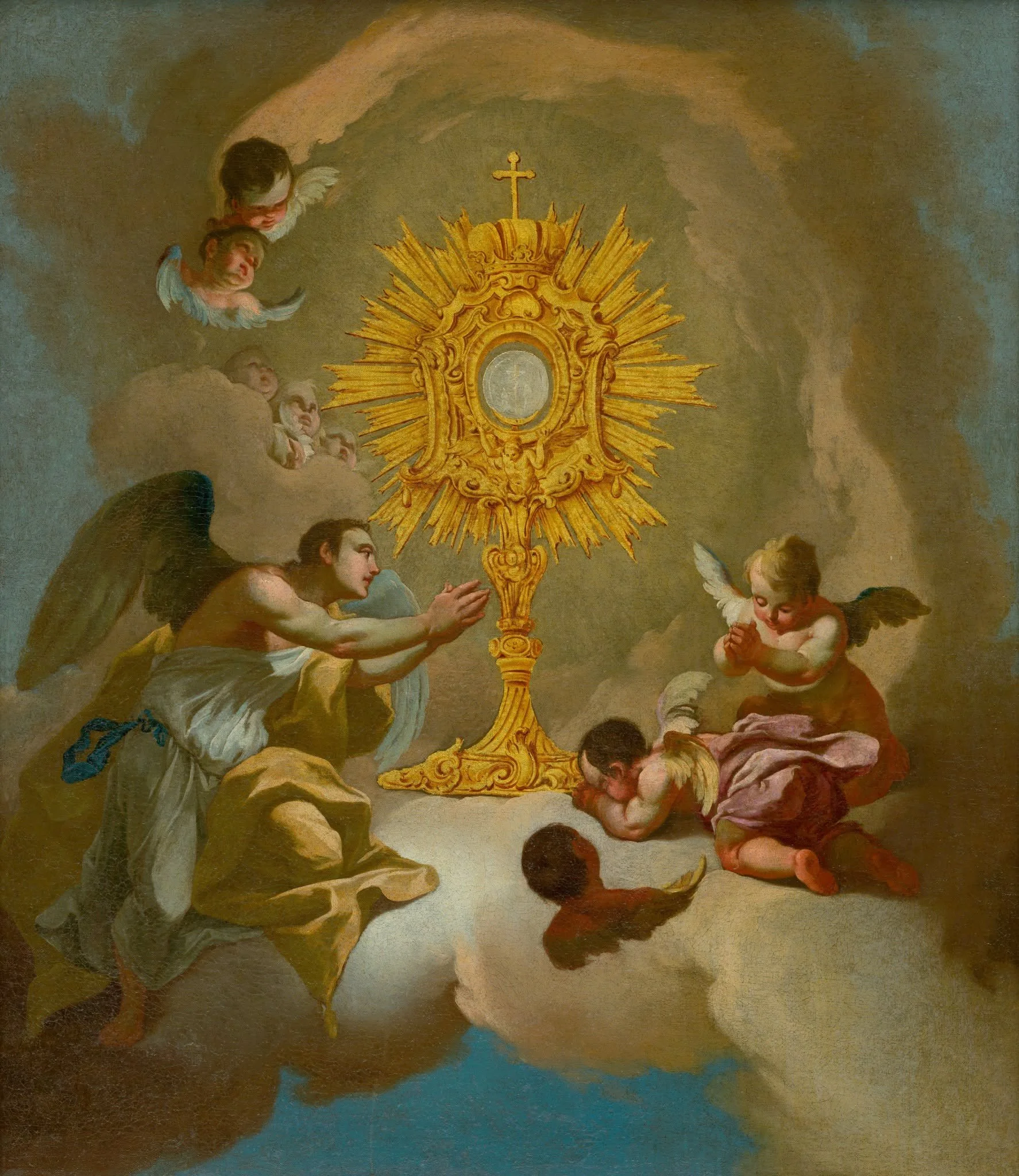
Below is the complete order of the Mass, provided here in full for reference and convenience.
THE INTRODUCTORY RITES
When the people are gathered, the Priest approaches the altar with the ministers while the Entrance Chant is sung. When he has arrived at the altar, after making a profound bow with the ministers, the Priest venerates the altar with a kiss and, if appropriate, incenses the cross and the altar. Then, with the ministers, he goes to the chair. When the Entrance Chant is concluded, the Priest and the faithful, standing, sign themselves with the Sign of the Cross,
while the Priest, facing the people, says:
In the name of the Father, and of the Son, and of the Holy Spirit.
The people reply: Amen.
Then the Priest, extending his hands, greets the people, saying:
The grace of our Lord Jesus Christ, and the love of God, and the communion of the Holy Spirit be with you all.
The people reply:
And with your spirit.
Then follows the Penitential Act, to which the Priest invites the faithful, saying:
I confess to almighty God and to you, my brothers and sisters, that I have greatly sinned, in my thoughts and in my words, in what I have done and in what I have failed to do, (And, striking their breast, they say): through my fault, through my fault, through my most grievous fault; (Then they continue): therefore I ask blessed Mary ever-Virgin, all the Angels and Saints, and you, my brothers and sisters, to pray for me to the Lord our God.
The absolution by the Priest follows:
May almighty God have mercy on us, forgive us our sins, and bring us to everlasting life.
The people reply:
Amen.
The Priest, or a Deacon or another minister, then says the following or other invocations* with Kyrie, eleison (Lord, have mercy):
You were sent to heal the contrite of heart:
Lord, have mercy. Or: Kyrie, eleison.
The people reply:
Lord, have mercy. Or: Kyrie, eleison.
The Priest:
You came to call sinners:
Christ, have mercy. Or: Christe, eleison.
The people:
Christ, have mercy. Or: Christe, eleison.
The Priest:
You are seated at the right hand of the Father to intercede for us:
Lord, have mercy. Or: Kyrie, eleison.
The people:
Lord, have mercy. Or: Kyrie, eleison.
The absolution by the Priest follows:
May almighty God have mercy on us, forgive us our sins, and bring us to everlasting life. The people reply: Amen.
Then, when it is prescribed, this hymn is either sung or said:
Glory to God in the highest, and on earth peace to people of good will. We praise you, we bless you, we adore you, we glorify you, we give you thanks for your great glory, Lord God, heavenly King, O God, almighty Father. Lord Jesus Christ, Only Begotten Son, Lord God, Lamb of God, Son of the Father, you take away the sins of the world, have mercy on us; you take away the sins of the world, receive our prayer; you are seated at the right hand of the Father, have mercy on us. For you alone are the Holy One, you alone are the Lord, you alone are the Most High, Jesus Christ, with the Holy Spirit, in the glory of God the Father. Amen.
When this hymn is concluded, the Priest, with hands joined, says:
Let us pray.
And all pray in silence with the Priest for a while.
Then the Priest, with hands extended, says the Collect prayer, at the end of which the people acclaim:
Amen
THE LITURGY OF THE WORD
Then the reader goes to the ambo and reads the First Reading, while all sit and listen. To indicate the end of the reading, the reader acclaims:
The word of the Lord.
All reply:
Thanks be to God.
The psalmist or cantor sings or says the Psalm, with the people making the response.
After this, if there is to be a Second Reading, a reader reads it from the ambo, as above. To indicate the end of the reading, the reader acclaims:
The word of the Lord.
All reply:
Thanks be to God.
There follows the Alleluia or another chant laid down by the rubrics, as the liturgical time requires. Meanwhile, if incense is used, the Priest puts some into the thurible. After this, the Deacon who is to proclaim the Gospel, bowing profoundly before the Priest, asks for the blessing, saying in a low voice:
Your blessing, Father.
The Priest says in a low voice:
May the Lord be in your heart and on your lips, that you may proclaim his Gospel worthily and well, in the name of the Father, and of the Son, and of the Holy Spirit.
The Deacon signs himself with the Sign of the Cross and replies:
Amen.
If, however, a Deacon is not present, the Priest, bowing before the altar, says quietly: Cleanse my heart and my lips, almighty God, that I may worthily proclaim your holy Gospel. 15. The Deacon, or the Priest, then proceeds to the ambo, accompanied, if appropriate, by ministers with incense and candles.
There he says:
The Lord be with you.
The people reply:
And with your spirit.
The Deacon, or the Priest:
A reading from the holy Gospel according to N.
And, at the same time, he makes the Sign of the Cross on the book and on his forehead, lips, and breast.
The people acclaim:
Glory to you, O Lord.
Then the Deacon, or the Priest, incenses the book, if incense is used, and proclaims the Gospel.
At the end of the Gospel, the Deacon, or the Priest, acclaims:
The Gospel of the Lord.
All reply:
Praise to you, Lord Jesus Christ.
Then he kisses the book, saying quietly:
Through the words of the Gospel may our sins be wiped away.
Then follows the Homily, which is to be preached by a Priest or Deacon on all Sundays and Holydays of Obligation; on other days, it is recommended. At the end of the Homily, the Symbol or Profession of Faith or Creed, when prescribed, is either sung or said:
I believe in one God, the Father almighty, maker of heaven and earth, of all things visible and invisible. I believe in one Lord Jesus Christ, the Only Begotten Son of God, born of the Father before all ages. God from God, Light from Light, true God from true God, begotten, not made, consubstantial with the Father; through him all things were made. For us men and for our salvation he came down from heaven, At the words that follow, up to and including and became man, all bow. and by the Holy Spirit was incarnate of the Virgin Mary, and became man. For our sake he was crucified under Pontius Pilate, he suffered death and was buried, and rose again on the third day in accordance with the Scriptures. He ascended into heaven and is seated at the right hand of the Father. He will come again in glory to judge the living and the dead and his kingdom will have no end. I believe in the Holy Spirit, the Lord, the giver of life, who proceeds from the Father and the Son, who with the Father and the Son is adored and glorified, who has spoken through the prophets. I believe in one, holy, catholic and apostolic Church. I confess one Baptism for the forgiveness of sins and I look forward to the resurrection of the dead and the life of the world to come. Amen.
Instead of the Niceno-Constantinopolitan Creed, especially during Lent and Easter Time, the baptismal Symbol of the Roman Church, known as the Apostles’ Creed, may be used.
I believe in God, the Father almighty, Creator of heaven and earth, and in Jesus Christ, his only Son, our Lord, At the words that follow, up to and including the Virgin Mary, all bow. who was conceived by the Holy Spirit, born of the Virgin Mary, suffered under Pontius Pilate, was crucified, died and was buried; he descended into hell; on the third day he rose again from the dead; he ascended into heaven, and is seated at the right hand of God the Father almighty; from there he will come to judge the living and the dead. I believe in the Holy Spirit, the holy catholic Church, the communion of saints, the forgiveness of sins, the resurrection of the body, and life everlasting. Amen.
Then follows the Universal Prayer, that is, the Prayer of the Faithful or Bidding Prayers.
THE LITURGY OF THE EUCHARIST
When all this has been done, the Offertory Chant begins. Meanwhile, the ministers place the corporal, the purificator, the chalice, the pall, and the Missal on the altar. It is desirable that the faithful express their participation by making an offering, bringing forward bread and wine for the celebration of the Eucharist and perhaps other gifts to relieve the needs of the Church and of the poor. The Priest, standing at the altar, takes the paten with the bread and holds it slightly raised above the altar with both hands, saying in a low voice:
Blessed are you, Lord God of all creation, for through your goodness we have received the bread we offer you: fruit of the earth and work of human hands, it will become for us the bread of life.
Then he places the paten with the bread on the corporal. If, however, the Offertory Chant is not sung, the Priest may speak these words aloud; at the end, the people may acclaim:
Blessed be God for ever.
The Deacon, or the Priest, pours wine and a little water into the chalice, saying quietly:
By the mystery of this water and wine may we come to share in the divinity of Christ who humbled himself to share in our humanity.
The Priest then takes the chalice and holds it slightly raised above the altar with both hands, saying in a low voice:
Blessed are you, Lord God of all creation, for through your goodness we have received the wine we offer you: fruit of the vine and work of human hands, it will become our spiritual drink.
Then he places the chalice on the corporal. If, however, the Offertory Chant is not sung, the Priest may speak these words aloud; at the end, the people may acclaim:
Blessed be God for ever.
After this, the Priest, bowing profoundly, says quietly:
With humble spirit and contrite heart may we be accepted by you, O Lord, and may our sacrifice in your sight this day be pleasing to you, Lord God.
If appropriate, he also incenses the offerings, the cross, and the altar. A Deacon or other minister then incenses the Priest and the people.
Then the Priest, standing at the side of the altar, washes his hands, saying quietly:
Wash me, O Lord, from my iniquity and cleanse me from my sin. Standing at the middle of the altar, facing the people, extending and then joining his hands, he says:
Pray, brethren (brothers and sisters), that my sacrifice and yours may be acceptable to God, the almighty Father.
The people rise and reply:
May the Lord accept the sacrifice at your hands for the praise and glory of his name, for our good and the good of all his holy Church.
Then the Priest, with hands extended, says the Prayer over the Offerings, at the end of which the people acclaim:
Amen.
Then the Priest begins the Eucharistic Prayer. Extending his hands, he says:
The Lord be with you.
The people reply:
And with your spirit.
The Priest, raising his hands, continues:
Lift up your hearts.
The people:
We lift them up to the Lord.
The Priest, with hands extended, adds:
Let us give thanks to the Lord our God.
The people:
It is right and just.
The Priest, with hands extended, continues the Preface
At the end of the Preface he joins his hands and concludes the Preface with the people, singing or saying aloud:
Holy, Holy, Holy Lord God of hosts. Heaven and earth are full of your glory. Hosanna in the highest. Blessed is he who comes in the name of the Lord. Hosanna in the highest.
The priest then continues with the Eucharistic Prayer
THE COMMUNION RITE
After the doxology at the end of the Eucharistic Prayer, and after the chalice and paten have been set down, the Priest, with hands joined, says: At the Savior’s command and formed by divine teaching, we dare to say:
He extends his hands and, together with the minister, continues:
Our Father, who art in heaven, hallowed be thy name; thy kingdom come, thy will be done on earth as it is in heaven. Give us this day our daily bread, and forgive us our trespasses, as we forgive those who trespass against us; and lead us not into temptation, but deliver us from evil.
With hands extended, the Priest alone continues, saying:
Deliver us, Lord, we pray, from every evil, graciously grant peace in our days, that, by the help of your mercy, we may be always free from sin and safe from all distress, as we await the blessed hope and the coming of our Savior, Jesus Christ.
He joins his hands. The minister concludes the prayer, acclaiming:
For the kingdom, the power and the glory are yours now and for ever.
Then the Priest, with hands extended, says aloud:
Lord Jesus Christ, who said to your Apostles: Peace I leave you, my peace I give you, look not on our sins, but on the faith of your Church, and graciously grant her peace and unity in accordance with your will.
He joins his hands.
Who live and reign for ever and ever.
The minister replies:
Amen.
The Priest, facing the minister, extending and then joining his hands, adds:
The peace of the Lord be with you always.
The minister replies:
And with your spirit.
Then, if appropriate, the Priest gives the sign of peace to the minister.
Then he takes the host and breaks it over the paten, while the minister says:
Lamb of God, you take away the sins of the world, have mercy on us. Lamb of God, you take away the sins of the world, have mercy on us. Lamb of God, you take away the sins of the world, grant us peace.
The Priest places a small piece in the chalice, saying quietly:
May this mingling of the Body and Blood of our Lord Jesus Christ bring eternal life to us who receive it.
Then the Priest, with hands joined, says quietly:
Lord Jesus Christ, Son of the living God, who, by the will of the Father and the work of the Holy Spirit, through your Death gave life to the world, free me by this, your most holy Body and Blood, from all my sins and from every evil; keep me always faithful to your commandments, and never let me be parted from you.
Or:
May the receiving of your Body and Blood, Lord Jesus Christ, not bring me to judgment and condemnation, but through your loving mercy be for me protection in mind and body and a healing remedy.
The Priest genuflects, takes the host and, holding it slightly raised above the paten or above the chalice, while facing the minister, says aloud:
Behold the Lamb of God, behold him who takes away the sins of the world. Blessed are those called to the supper of the Lamb.
And together with the minister he adds once:
Lord, I am not worthy that you should enter under my roof, but only say the word and my soul shall be healed.
If the minister is not to receive Communion, the Priest, having taken up the host, immediately says,
Lord, I am not worthy,
The Priest then says quietly:
May the Body of Christ keep me safe for eternal life.
And he reverently consumes the Body of Christ.
Then he takes the chalice and says quietly:
May the Blood of Christ keep me safe for eternal life.
And he reverently consumes the Blood of Christ.
Meanwhile the minister recites the Communion Antiphon. After this, the Priest takes the paten and approaches the minister, if he is to receive Communion, and raises a host slightly, showing it to the minister and saying:
The Body of Christ.
The minister replies:
Amen.
And receives Holy Communion.
Then the Priest purifies the paten over the chalice and also the chalice itself. The chalice, paten, corporal and purificator are taken by the minister to the credence table or left on the altar. While he carries out the purification, the Priest says quietly:
What has passed our lips as food, O Lord, may we possess in purity of heart, that what has been given to us in time may be our healing for eternity.
A sacred silence may be observed for a while. Then, with hands joined, the Priest says:
Let us pray.
After a brief pause for silence, unless silence has just been observed, he extends his hands and says the Prayer after Communion, at the end of which the minister acclaims:
Amen.
The Concluding Rites
Then the Priest, facing the minister and extending his hands, says:
The Lord be with you.
The minister replies:
And with your spirit.
The Priest blesses the minister, saying:
May almighty God bless you, the Father, and the Son, and the Holy Spirit.
The minister replies:
Amen.
Then the Priest venerates the altar with a kiss, and after making a profound bow with the minister, he withdraws.