

Vessels and vestments
Sacred Vessels, Vestments & Sanctuary Objects
Ever wondered what the items on the altar are called—or why the priest wears specific garments? Filter by category below and tap any card to uncover its biblical and spiritual meaning.
Altar Vessel
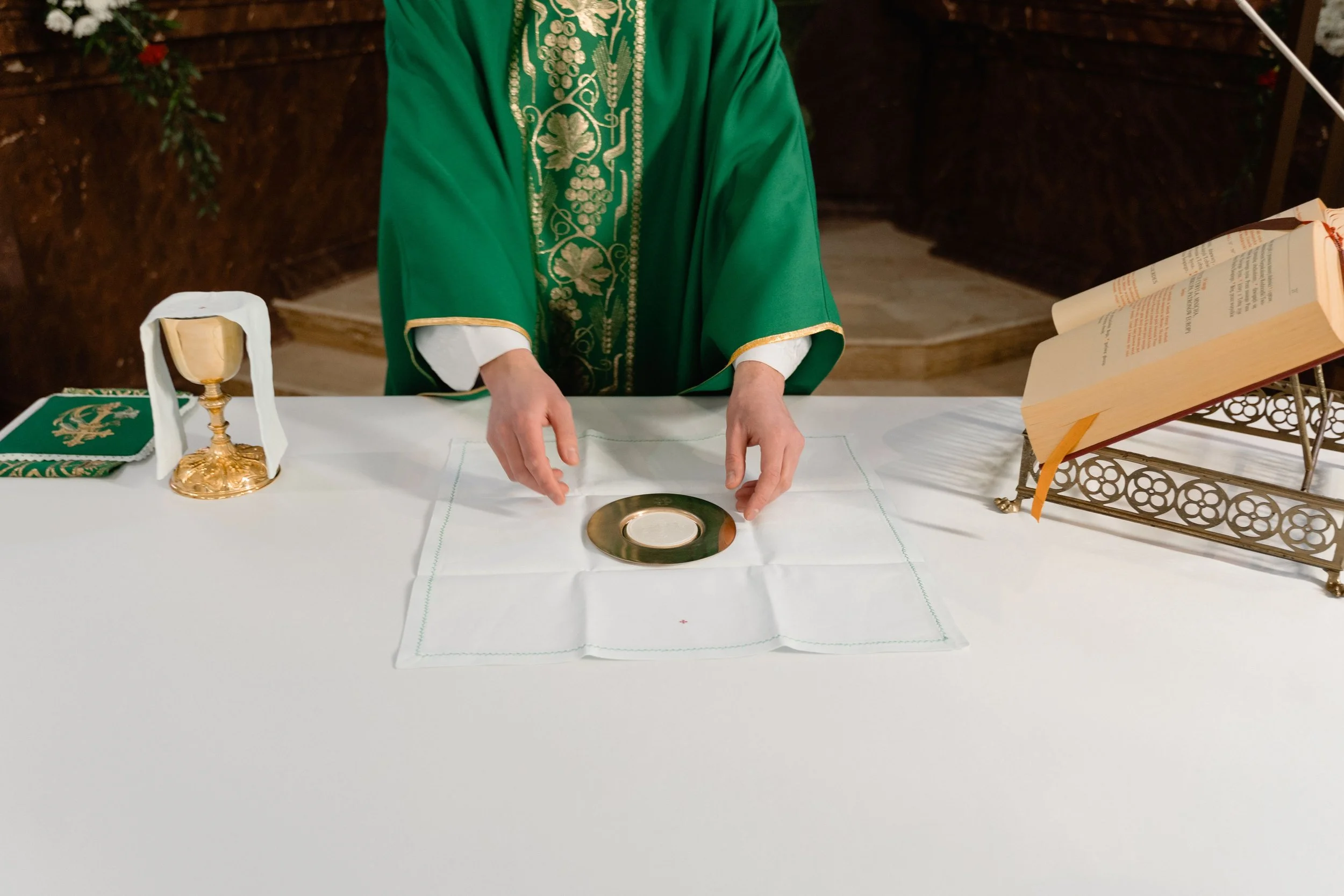
Chalice
Pronounced: CHAL-iss
The sacred cup that holds the wine consecrated into the Blood of Christ.
Because it holds the Precious Blood, the inside of a chalice is traditionally lined with gold or precious metal that will not tarnish or corrode—honoring the dignity of the Eucharist.
When you see it: Preparation of the Gifts through Holy Communion.
Altar Vessel
Paten
Pronounced: PAT-en
The shallow, saucer-like plate that holds the large host consecrated by the priest.
Like the chalice, the paten is typically gold-plated. Its open, flat shape symbolizes the sacrificial offering of Christ's Body laid upon the altar.
When you see it: Placed on the center of the altar during the Offertory and Consecration.
Altar Vessel
Ciborium
Pronounced: sih-BOR-ee-um
A covered chalice-like bowl used to hold the smaller hosts distributed to the congregation.
After Mass ends, any remaining consecrated hosts are placed inside a covered ciborium and reserved inside the Tabernacle so Communion can be brought to the sick and homebound.
When you see it: Brought from the Tabernacle or altar during Holy Communion.
Altar Vessel
Monstrance
Pronounced: MON-strunts
An ornate, sunburst-shaped vessel used to display the consecrated Host during Eucharistic Adoration.
Its name comes from the Latin word monstrare ("to show"). While not used during regular Mass, you will see it during Holy Hours, Benediction, and Corpus Christi processions.
When you see it: Eucharistic Adoration and Benediction services.
Altar Vessel & Linen
Cruets & Corporal
Pronounced: KROO-its & KOR-puh-rul
Small glass pitchers holding the water and wine, and the square white linen cloth placed under the chalice.
The Corporal (from the Latin corpus, meaning "body") is unfolded squarely in the center of the altar to catch any tiny particles of the consecrated Host.
When you see them: Brought to the altar during the Preparation of the Gifts.
Priest's Vestment
Chasuble
Pronounced: CHAZ-yoo-bul
The outer, poncho-like colored garment worn by the priest celebrating Mass.
Originally a Roman outer cloak, the chasuble symbolizes the "yoke of Christ" and charity covering all things. Its color changes with the liturgical season (green, purple, white, or red).
When you see it: Worn exclusively by the priest throughout the entire Mass.
Priest's Vestment
Stole
Pronounced: STOHL
A long, narrow band of colored cloth worn around the neck by priests and diagonally across the chest by deacons.
The stole is the primary symbol of ordained ministry and the authority to administer the sacraments. A priest wears it underneath his chasuble during Mass.
When you see it: Worn at Mass, Confessions, Baptisms, and Weddings.
Priest's Vestment
Alb
Pronounced: ALB
The full-length white linen tunic worn underneath outer vestments by priests, deacons, and altar servers.
From the Latin albus ("white"), the alb recalls the white garment given at Baptism—symbolizing purity of heart and equality in Christ before God.
When you see it: The base layer worn by all liturgical ministers at the altar.
Priest's Vestment
Dalmatic
Pronounced: dal-MAT-ik
The sleeved outer tunic worn by a deacon during Mass, matching the priest's liturgical color.
Unlike the sleeveless chasuble worn by the priest, the dalmatic has wide sleeves—representing the deacon's specific ministry of active service to the Church and the poor.
When you see it: Worn by a deacon assisting at Sunday or solemn Masses.
Priest's Vestment
Cincture
Pronounced: SINK-chur
The braided rope belt tied around the waist over the alb to secure the vestment and stole.
Rooted in Jesus's command to "gird your loins" for service (Luke 12:35), the cincture symbolizes chastity, self-mastery, and readiness to serve God.
When you see it: Tied around the waist of priests, deacons, and altar servers.
Sanctuary & Church
Tabernacle
Pronounced: TAB-er-nak-ul
The ornate, locked safe in the sanctuary where the consecrated Eucharist is reserved.
Because Catholics believe Jesus is truly present in the consecrated hosts, people genuflect (touch one knee to the floor) toward the Tabernacle when entering or leaving a pew.
When you see it: Located centrally behind or beside the main altar.
Sanctuary & Church
Sanctuary Lamp
Pronounced: SANK-choo-air-ee LAMP
The continuously burning candle (usually in a red glass holder) hanging near the Tabernacle.
A lit sanctuary lamp signals to everyone entering the church that the consecrated Body of Christ is present inside the Tabernacle. It is only extinguished on Good Friday.
When you see it: Burning day and night beside the Tabernacle.
Sanctuary & Church
Ambo
Pronounced: AM-boh
The elevated lectern or pulpit from which the Scripture readings and Gospel are proclaimed.
The Church views the Mass as nourishing us from two "tables"—the Table of God's Word (the Ambo) and the Table of Christ's Body (the Altar).
When you see it: During the First Reading, Psalm, Second Reading, Gospel, and Homily.
Sanctuary & Church
Thurible (Censer)
Pronounced: THUR-ih-bul
The metal incense burner suspended on chains that is swung during solemn Masses.
Rising smoke symbolizes our prayers ascending to Heaven (Psalm 141:2) and sets apart sacred people and objects—such as the altar, the Gospel book, the gifts, and the congregation.
When you see it: Sundays, solemn feast days, funerals, and Eucharistic Adoration.
Sanctuary & Church
Holy Water Font & Aspergillum
Pronounced: FONT & as-per-JIL-um
The water basins at church entrances and the metal sprinkler used by the priest to bless the assembly.
Dipping your fingers in holy water and making the Sign of the Cross upon entering the church is a physical reminder of your Baptism and spiritual cleansing before worship.
When you see them: At every church door and during Sunday sprinkling rites.